
Queer writer Scott Broker has driven the literary miles to his novel debut, including having written a previous book that never paired with a publisher. He’s also been a Tin House Scholar; a finalist for the Iowa Review Prize in Fiction and the New England Review’s Emerging Writer Award; and a nominee for three Pushcart Prizes.
Scott and I were Lambda Literary Fellows the same year. With his The Disappointment set for release by Catapult on March 3, 2026, we caught up about who owns the meaning of work, writing characters who are creatives, and more.
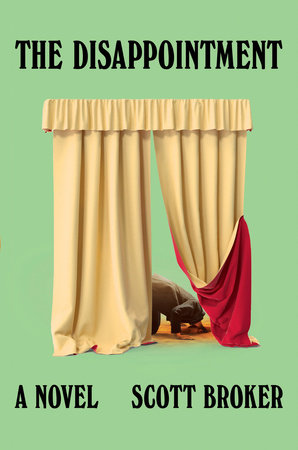
Pre-order The Disappointment here.
Todd: The Disappointment seems perfectly poised for book clubs to argue about what the actual disappointment in the book is. How do you feel about readers deciding this, rather than the author? What advice would you give to a writer who is set on controlling the meaning of their work?
Scott: The passing around of meaning is one of the great delights of putting your work out there. It is also one of the great aggravators. But my feeling is that you can’t have one without the other, and that the positive side of this circulation weighs far more heavily when all is said and done. With every new reading, the book’s meaning expands.
To those controlling authors, among whom I have sometimes been a part, I say: Delight in the collision between your work and the reader’s life! Of course your writing can’t land how you want each time…but only because it is landing on a new shore. I like to think of this meeting point as synergistic, rather than antagonistic.
TW: Setting the majority of the book in a far-flung small town has allowed you to feature the kind of surreal characters one might meet in certain, far-flung small towns. What was your strategy for making sure the characters had veracity in the book’s setting?
SB: The main reason I wanted to place the novel in Florence was that, as a seasonal small town, it has a certain liminal quality inherent to the place. It bloats in the summer and shrinks in the winter; its permanent population is far outnumbered by vacationing tourists who rummage through it every year. These things do something to a place, both materially and immaterially. The concerns of the novel are also very liminal, and so the pairing felt snug.
Regarding the locals, I certainly had fun playing around with certain small town tropes, but only (I hope) in terms of initial impressions. The characters teeter on caricaturish in their wonky charm. Poked a little more, though, and they give way to wide interior landscapes shaped by loss, longing, desire, and more.
To the notion of veracity, I hope they seem both true to the place (who hasn’t had an odd encounter in a town like this?) but also true to a more complex humanity that superficial tropes don’t do any real justice.
The passing around of meaning is one of the great delights of putting your work out there. – Scott Broker
TW: The novel lets its creatives wrestle with how much of a life should be given over to the art someone is called to make. One character even seems to believe the critical acceptance of someone’s art leads to the creator being valuable versus a failure. What was the inspiration for these topics? What stories have you witnessed that brought these concerns to the text?
SB: I wrote this at a time of personal “failure,” though I hesitate to call it that. I guess I could say personal disappointment (ha) that felt at the time like sheer failure. I’d written another novel, worked quite hard on it with my agent, then watched it languish and eventually perish on the submission front. It’s hard to brace for the experience of having years of work be met with silence, form rejections, or personalized rejections that unveil all of the sides of publishing (marketability, etc.) you’d rather not be conscious of.
I also had a surprising amount of feedback about the experiences of the narrator seeming too alienating. That didn’t help much with my abandonment issues, which the novel was primarily about.
I didn’t consider stopping writing, but I did grapple a lot with the uncertainty of an unknown creative future. At the same time, I watched other friends face similar struggles, some of whom did stop pursuing their art. Seeing how that decision yanked them all the way from anguish to liberation and back again was amazing to witness. It helped unravel some of my own ideas about what the “right choice” for any one person is. Sometimes quitting is the best thing, and sometimes it isn’t.
TW: Which author would you tour with if you could? What would you hope audiences would glean from you touring together?
SB: Oh boy, there are so many writers I’d love to talk with. I might cheat and name a few, if only for the chance to recommend multiple authors: Laura van den Berg, Marie-Helene Bertino, Marie NDiaye, and Patrick Cottrell were all steady guides when it came to drafting this book.
For me, they are all high benchmarks of how one navigates the (perceived) rift between reality and unreality. That’s what I’d like to discuss with them: how you let the logical realm of your story tatter and fray in a manner that happens almost subconsciously, so that by the time the reader realizes they’ve drifted into a dreamlike elsewhere, they’re already neck deep.
It’s hard to brace for the experience of having years of work be met with silence… – Scott Broker
TW: The anxiety you capture cycling in and about the featured male-male couple reads like you have grasped some important common universal experiences of queer men. Without giving away the ending, what do you hope queer men reflect on from reading this book?
SB: I’m not sure if it’s a reflection I’m hopeful for so much as a feeling of recognition, or possibly even commiseration. Jack in particular experiences some anxiety that is inextricably tied up with being bisexual, and I hope anyone out there who has had similar stresses (god knows I have) sees an experience that might not reflect their own exactly but that honors their own by virtue of its own nuance and complexity.
TW: What’s something recent in life that’s made you smile?
SB: On the page: Patrick deWitt’s French Exit, Thomas Bernard’s Woodcutters, Madeline Cash’s Lost Lambs.
On the screen: The Chair Company.
On the surface of the globe: my five nieces and nephews, who riotously span the ages of 1 to 6.
Pre-order The Disappointment here.
 toddwe.com